Wednesday, December 8, 2010

Persepolis

Persepolis
 by Marjane Satrapi

Bibliography

Satrapi, M. (2003).  Persepolis. New York, NY: Pantheon Books. ISBN 978-0375714573

Summary

Persepolis tells the story of the author from ages 10 to 14 as she grows up in a changing Iran.  Her parents are political radicals during the upheaval of the Islamic Revolution and 1980's.  This combined with her education eventually put her in danger and cause her parents to send her to Austria.

Critical Analysis

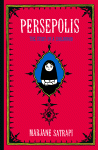
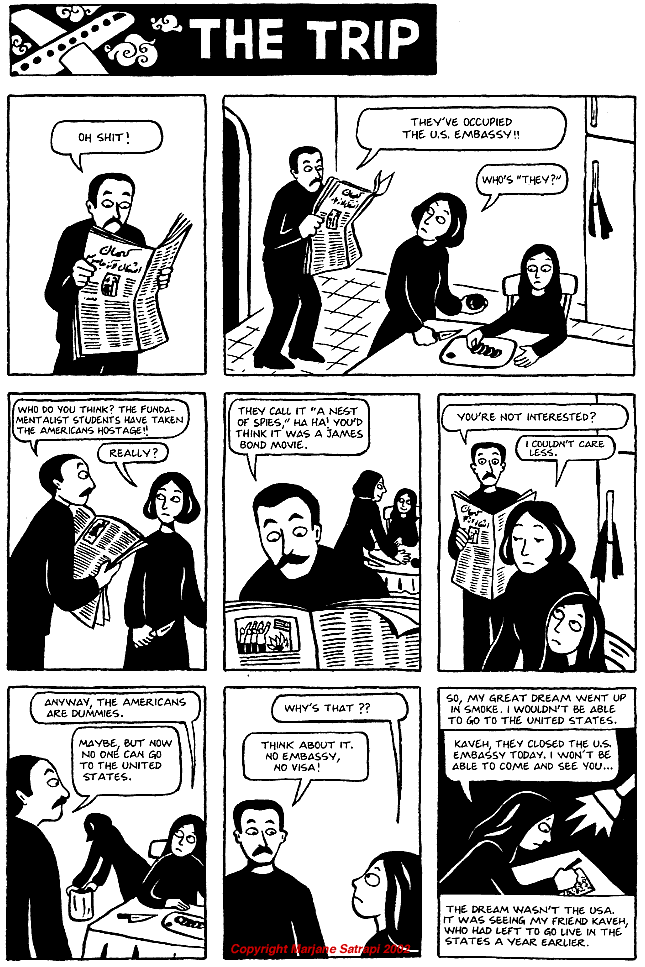
Persepolis may not catch the interest of a young adult reader at first glance.  The cover looks old and the drawings are all black and white.  But once inside, the story is strong and engaging and the graphic art is humorous and tells the story well.

This book can cross audiences well  as adults will be just as engaged by the behind the scenes memoir of a young girl growing up during this era.  It gives us a glimpse into a world we are unfamiliar with, yet that plays a part in many of our lives. For young adult readers, Marjane's youthful rebelliousness and idealism make her easy to identify with.

Review Excerpts

* Despite the grimness, Satrapi never lapses into sensationalism or sentimentality. Skillfully presenting a child's view of war and her own shifting ideals, she also shows quotidian life in Tehran and her family's pride and love for their country despite the tumultuous times. -- Publisher's Weekly

* This is a graphic novel of immense power and importance for Westerners of all ages. -- School Library Journal


Connections

* Here is information about Marjane Sartrapi and her work, including excerpts and historical context.

* Expert from Persepolis

Dark Sons

Dark Sons
 by Nikki Grimes

Bibliography

Grimes, N. (2005).  Dark sons. New York, NY: Hyperion Books for Children. ISBN 9781415627426

Summary

Isaac and Ishmael - an ancient story. Ishmael is driven from his father, yet manages to become a great nation. Divorce - a modern story.  Sam's father leaves home, re-marries, and has a child. Nikki Grimes parallels the biblical story of Ishmael to the modern story of Sam in a series of poems and shows how faith in God and sometimes even kisses from a pretty girl can help people through difficult times.

Critical Analysis

Like any good novel written for young adults, Dark Sons draws the reader into the narrative.  Readers can identify with Sam, and through him, they can identify with Ishmael.  The difference with this novel is that the narrative is written in the form of poetry and many typical literary elements do not play as strong a role as in prose novels.  Grimes' free verse poetry is both modern, edgy, and beautiful.  The poems clearly portray feelings such as betrayal, loneliness, and finally, hope.

Review Excerpts

* The cross-play is effective, though Sam's story is more vivid and engaging. References to God (not Jesus) layer another father into the mix. Religion is a key part of the healing, but even faith-challenged readers can admire and learn from these stories of struggle in vernacular verse. -- School Library Journal

* The simple words eloquently reveal what it's like to miss someone ("I've stopped expecting / his shadow in the hallway / his frame in the doorway"), but even more moving is the struggle to forgive and the affection each boy feels for the baby that displaces him. The elemental connections and the hope ("You made it / in the end / and so will I") will speak to a wide audience. -- Booklist


Connections

* This website has an audio except, teaching guide, more reviews, and an awards list for Dark Sons.  Well worth a look.

* Expert from Dark Sons

Three Tents (Ishmael)
"Three tents:
His, hers, ours,
goatskin fortresses
separated by severed promises,
cultural circumstances,
and yards of useless pride.
Even so,
we are joined together
by one invisible, thread:
Blood
red."

Two Houses (Sam)
"Trading spaces
makes me dizzy.
Two houses,
two beds,
two dressers,
two closets,
two sets of rooms
and rules,
two sets of parents
who split on
the shoulds and shouldn'ts.
Einstein would have trouble
keeping track.
I lack the finesse, myself,
and so sometimes
I throw my hands up,
go for a walk, and tell
the so-called grownups
to work it out."

Your Own, Sylvia

Your Own, Sylvia
 by Stephanie Hemphill

Bibliography

Hemphill, S (2007). Your own, Sylvia. New York, NY: Knopf Books for Young Readers. ISBN 9780329643362

Summary

Your Own, Sylvia is a book of poems that provides a glimpse into the life of Sylvia Plath.  Each poem is written from the perspective of someone who knew Sylvia or in the style of one of Sylvia's own poems. Sylvia Plath's vibrant personality, her struggle with mental illness, her personal relationships, and her suicide are all portrayed through the poems.

Critical Analysis

Your Own, Sylvia is accurately subtitled A Verse Portrait of Sylvia Plath.  After reading the novel, you will come away feeling you know Sylvia better, and you will probably want to explore more about her.

Hemphill has done a good job writing the free-verse poems.  Some are full of beautiful language, some sound like they are coming from the mouth of the person they are credited to, all blend into a pleasing narrative which will attract the young adult reader.

Review Excerpts

* While the book will prove an apt curriculum companion to Plath's literary works as touted on the jacket, it will also pull the next generation of readers into the myth of Sylvia Plath. -- School Library Journal

* The result is an intimate, comprehensive, imaginative view of a life that also probes the relationships between poetry and creativity, mental fragility, love, marriage, and betrayal.-- Booklist


Connections

*Other titles worth reading by Stephanie Hemphill
  • Things Left Unsaid: A Novel in Poems (2005)
  • Easy (2007) 
  • Wicked Girls: A Novel of the Salem Witch Trials (2010)
* Expert from Your Own, Sylvia

Madness
Dr. Ruth Barnhouse Beuscher, Sylvia's therapist
Fall 1953

Repression cuts off
circulation like a tourniquet,
and Sylvia throbs with desire.

I advise Sylvia to experiment,
to stop fretting over a white
wedding dress. Does this shock
the patient? Not really.
Sylvia has been slicing at her arm,
waiting for someone
to grant her permission. A junior in college,
she may be ready for this.
'But what would Mother think?'
Sylvia snickers. She wraps a mink stole
of secrets around her shoulders,
luxuriates in playing foul
behind her mother's back.

Perhaps when she holds back
her desires, her mind
splinters into madness, into deadwood
that we must burn away by electric shock.
I encourage her to release her idea
of the bad girl, punishable for physical contact.

I ask her to think about herself, not her mother,
about how Sylvia represses Sylvia.
I want to tell her to do what she wants.
I need to help her to let go of her fears."


Dr. Ruth met with Sylvia for daily psychotherapy sessions, during which Ruth explained to Sylvia her methods and techniques and why she was using them. Sylvia responded well to this sort of inclusion and respect. Dr. Barnhouse Beuscher employed fairly orthodox Freudianism, which entailed leading analysis and discussion about Sylvia's childhood. At the time of the above poem, Sylvia and Dr. Ruth met at McLean Hospital for inpatient treatment, but later they would have sessions at Dr, Beuscher's private practice. They were in contact via phone, letters, or in person every week until Sylvia's death ten years later.